Tuesday, 7 August 2018

Sunday, 5 August 2018
Bad Weather? Watch 5 Films for a Rainy Day
Summer is in full swing. Now that school’s been out for a while, I’m wondering how long it took for some of you to get the “I’m booooored” cry from the kids. When the sun is shining you can kick them outside, but what to do when it’s a rainy day?
Have no fear! The NFB once again comes to the rescue with this handy selection of films. Intended for the young, but enjoyable for the whole family, these 5 kids’ films will unlock the imagination and provide temporary respite from the bad weather outdoors. Enjoy!
Blackberry Subway Jam
Robert Munsch books and kids go together like… peanut butter and blackberry jam. If you’ve got kids, then no doubt you’ve worked your way through Mortimer, Put Me in a Book, and The Paper Bag Princess. You’ve possibly even sobbed your way through I’ll Love You Forever.
This film is based on the story of a young boy whose mother has one simple request – keep the house clean. In theory, that shouldn’t be too much trouble. However, if you’ve got a kid like mine (who we lovingly refer to as Pig Pen), you’ll know that this can present a challenge.
In this film, our young hero, Jonathan, has every intention of keeping the apartment clean, but this proves impossible when he discovers it’s being used as a subway stop. I mean, how else would you explain the utter and complete mess that’s waiting for his mother when she returns home?
But no worries! Jonathan knows just what to do. He heads down to city hall to meet the man who runs the city and discovers first-hand the joys of bureaucratic red tape. It’s a good life lesson for when you’re stuck indoors on a rainy day….
oehttps://https://ift.tt/2ALFKxS
The Trout That Stole the Rainbow
When you want to get a message across, especially to young minds, there’s no better route than the fable. The fable is a classic literary device that uses animals, which have often been imbued with human-like traits, to tell a story that teaches us a moral.
In this film, we meet a trout who’s envious of all the colour found in the world, especially in the rainbow after a storm. The little trout feels he’s led a grey existence and is tired of watching all the beautiful colours from afar. Determined to possess some of that beauty, he makes a giant leap after the storm and swipes the rainbow from the sky.
But now what? While the trout gets to lay at the bottom of the river, wrapped in his technicolour robe, the rest of the world must suffer the consequences. Turns out, when you take the rainbow from the sky, you essentially run off with all the colours in the world.
This is an important lesson for kids – the difference between appreciating beauty and possessing it; the line between enjoying something and using it selfishly. This is a gentle film that manages to convey its point without being too preachy. And the resolution at the end is sure to stay with young minds for a long time.
oehttps://https://ift.tt/2vj0xU2
The Magic Flute
Gayle Thomas has a knack for making mesmerizing films. Have you seen Quilt? This film is no different. The animation and the colours, and the fact that it looks like the whole thing was done with crayons, are just spectacular. It’s a perfect kids’ film.
The film starts with a young boy, stuck inside on a bad weather day, when he finds a flute. A magic flute, as it turns out. Because when he plays the flute, the world around him is transformed. He shares this discovery with a friend, and together they experience the joy of discovering the world around them when the flute sings.
But things go a little awry when a jealous neighbour gets his hands on the flute. When he plays it, it’s not exactly rainbows and unicorns. Turns out, it’s not necessarily the flute that’s able to transform the world around you…
oehttps://https://ift.tt/2AHf4hN
The Sound Collector
In this film, two brothers are stuck inside on a rainy day. The younger one collects sounds, and the older one is just annoyed. He hates spending time with his brother and thinks he’s weird. Those of us with siblings know how difficult those relationships can be.
But Leonard is able to teach his brother a thing or two, and through the power of their imagination, a rainy day turns into a grand adventure.
This is a great kids’ film, teaching tolerance and the importance of relationships in addition to the overall story of a creative young boy. The perfect distraction on a rainy summer day.
oehttps://https://ift.tt/2OMVXG3
Big Drive
Apparently, the importance of a good imagination is a strong theme in these kids’ films.
This gem of a film is about a family road trip during a 1970’s summer. Having spent my own summers from 1977 – 1980-something doing the exact same thing, this film resonated hard with me. Just swap a couple of the sisters for brothers, and bam! That’s my family in the back of the station wagon.
The four sisters in this film sit together in the back seat as their parents drive across the prairies. They go through the typical stages of road-tripping but being amongst siblings amplifies everything four-fold. Or 16-fold. My math is terrible. They go from mere boredom to outright antagonizing until that old sister bond kicks in and they manage to salvage a potentially disastrous situation.
oehttps://https://ift.tt/2AHNYa2
The post Bad Weather? Watch 5 Films for a Rainy Day appeared first on NFB Blog.
Bad Weather? Watch 5 Films for a Rainy Day posted first on http://film-streamingsweb.blogspot.com
Thursday, 2 August 2018
Unsung Canadian Heroes: The Volunteer
This installment of Unsung Heroes brings us the volunteer. Volunteering is one of the most fulfilling things you can do. If you’ve never tried it, I highly recommend it.
Volunteers come in many different forms, each of them valuable and important in their own right. From firefighters to patrons of the arts, there’s a role for everyone to play. These films look at 5 of them.
this river
As we’re all aware, there is a horrifying epidemic of missing and murdered Indigenous women across Canada. Perhaps more horrifying is the lack of action being taken to stop it, or even investigate. As we’ve seen recently with Tina Fontaine and Coulten Boushie, justice for the Indigenous population isn’t exactly winning the day. So, when good people step forward and volunteer do something constructive, we can safely call those people heroes.
oehttps://https://ift.tt/2vdgr2j
Call for Volunteers
There’s no denying that women really stepped up during World War II, not only entering the workforce in droves, but also in a volunteer capacity. This 10-minute film shows how the women of Winnipeg enlisted 7000 other women who served as volunteers as part of the war effort. Thanks to their tireless work, they extended and maintained many social services, proving you didn’t need to be at the front to be a hero.
oehttps://https://ift.tt/2AClFtG
Jean Giguère: The Measure of a Place
Here is a woman who learned from an early age the importance of being a volunteer. Taught by nuns, she was participating in the concept as early as grade school. Her love of the arts stems from growing up in an arts-and-culture oriented family. If she wanted to keep up at dinner, she had to know her stuff. As such, Jean Giguère dedicated her life to serving the arts. In my view, this makes her a big hero. She claims that the arts are the common link that hold us together, and views it as a privilege to serve.
oehttps://https://ift.tt/2OC2lQ6
The Grasslands Project – After the Fire
When you think “hero” and “volunteer,” what’s the first thing to come to mind? Firefighters. These people must among the bravest human beings there are, and the most selfless. In this short, which is part of a larger series that looks at life across the southern prairies, we follow the Eastend Fire Department as they put out fires in barns and fields, and see firsthand the consequences that comes with the job.
oehttps://https://ift.tt/2AClG0I
Los Canadienses
Between 1936 and 1939, 1200 troops from the Mackenzie-Papineau Battalion joined together with 39,000 other soldiers in an effort to stop the threat of fascism in Spain. These are people who volunteered to go and fight in a country that was not their own, and did so to preserve peace around the world. Sadly, many of them did not return and this film pays tribute to them.
oehttps://https://ift.tt/2OGf8Bl
The post Unsung Canadian Heroes: The Volunteer appeared first on NFB Blog.
Unsung Canadian Heroes: The Volunteer posted first on http://film-streamingsweb.blogspot.com
Wednesday, 1 August 2018
Teaching Global Connections with Highrise and Universe Within
This is a guest post written by Merrianne Couture, who currently teaches English Literature at Dawson College in Montreal, QC. She has been teaching for over 20 years and occasionally offers “The City” theme course as a means to examine issues pertaining to social justice, equality and sustainability. Research interests include contemporary literatures, food, autobiography, memoir, comics and urban development.
Urban realities and global pedagogies: The city as metaphor
If you’re like me, and you live in Canada, you probably live in an urban environment: 80 percent of us do. In fact, globally speaking, more than 1 billion people live in urban highrises. As city populations grew, buildings developed vertically to accommodate these expanded living needs. The NFB and director Katerina Cizek bring some of these stories together in a series of short, interactive, multi-platform digital presentations. Teachers can use the three-minute clips, set in global communities, to enhance pedagogy for both group and independent study. I have found that this digital project provides an important critical context for social studies in the classroom.
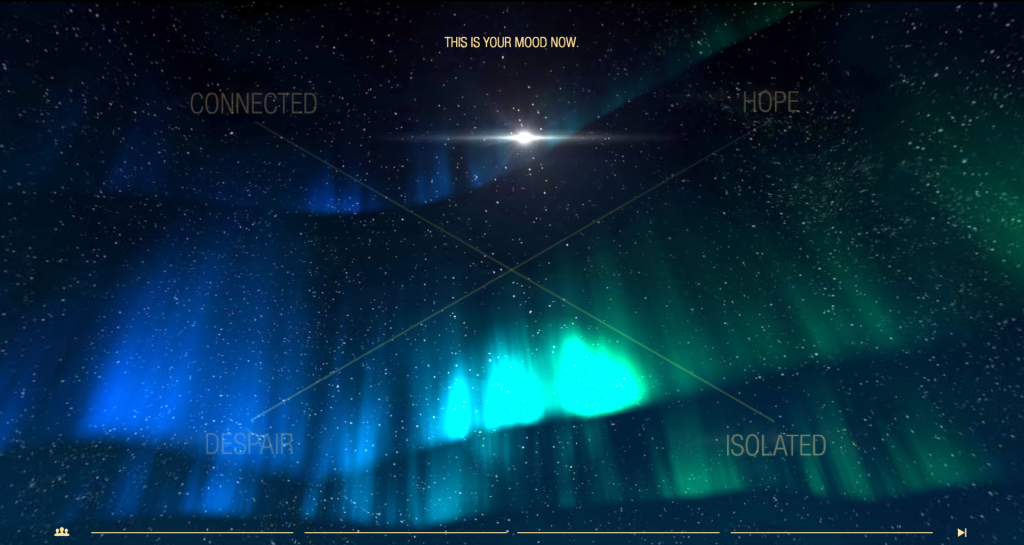
Highrise in the classroom: A framework for learning
Throughout the 20th century all over the world, the highrise emerged as a dominant vertical structure to house growing populations. Later came the digital revolution, and many of these highrise buildings became sites of resistance, innovation and social development. However, they were also sites of inequality, poverty and class separation. As global connections and social-justice awareness develop, the highrise is also becoming a central means of learning about the world around us. Studying the architecture and its inhabitants is a natural way toward global understanding. Highrise is a multi-platform project that can be used in the classroom to engage students in discovering social, geographic and economic issues while also developing media and research literacies.
Educational support for global connections and Universe Within
I have found that the project engages students effectively because the stories are personal and real. The study guide provides a framework to develop classroom activities using any of the three-minute video guides. In each of the micro-stories, socio-political realities are presented via the backdrop of these densely populated buildings. The 20th century arrives with a global population explosion, and the responses to accommodating this growth are not always equitable or sustainable. In many ways, the challenges of the individual stories represented in the Universe Within project mirror the global concerns of social and environment justice. From Ottawa to Accra, and Tokyo to New York City, students can actively engage with cultures and ideas presented by Universe Within. Teachers can easily adapt the study guide to promote identified learning objectives in several areas: social studies, geography, cultural studies, history, media literacy, critical thinking, reading, writing and research skills. The interactive nature of the project promotes effective learning, which can be adapted for outcome, age and grade level.
Universe Within
The study guide provides pedagogical opportunities that can be adapted for both individual and group work across a variety of grade levels. Discussion questions, independent research work and digital resources highlight the interactive nature of the platform. Class discussion on ethics, privacy, sexuality, surveillance and family stimulate multiple learning objectives.
The Canadian context and Universe Within in the classroom
In teaching urban issues, I begin with the local context and have students work together to research issues pertinent to their communities. From this, the course expands to elaborate on global connections and how we think we know the world. As students learn about Canadian contexts, they also begin to develop the critical-skills set essential to expanding analysis of complex global connections. Teachers can also promote media-literacy skills to reinforce these research, writing and critical-thinking skills. The project highlights some of the challenges of living in an urban context.
You might begin urban explorations with the story set in both Ottawa and St. John’s, NL. Cathy lives on her rural property outside St. John’s, but uses Wi-Fi-enhanced surveillance to keep tabs on her aging mother, who lives independently in Ottawa. The film explores the role of technology as a caretaking tool, but also brings to mind the larger questions of privacy, ethics and the caretaking obligations of family, especially in light of Canadian realities, which might see immediate families living some distance from one another.
As students work with these digital materials, they deepen their understanding of digital implications. I often feature social media in my classes as a tool to engage students. The interactive nature of Universe Within and its emphasis on individual stories illustrates how these communication platforms can also be tools of social justice in other contexts. The assumption may be that both highrise living and Internet technology decrease a united sense of community, but these stories illustrate some of the empowering possibilities of vertical living. Subject areas as diverse as human rights, religious practice and even online marriage enhance media and research literacies. Canada is home to diverse cultures, practices and attitudes.
Teachers can modify the materials to attain pedagogical objectives pertinent to grade levels (7–12).
More global connections in a digital world: Universe Within
Effective learning in my classroom means that students are able to get beyond their own living situations toward accepting diverse views and global realities. As mentioned, several of the segments of Universe Within provide students with a means of learning about international issues and the impact of Internet technology. Most of my students have never known the world without a digital connection, and I like to frame the classroom experience with concrete examples to illustrate how urban areas have adapted technology to specific contexts. In the featured story from Guangzhou, China’s third-largest city, viewers meet Ling, who lives in a highrise apartment with her parents. She has arranged a “mock marriage” (via the Internet) to a gay man so that her parents do not learn of her lesbian identity.
oehttps://https://ift.tt/2Kf76f3
Ling’s story highlights the important formative experiences of one young person who uses the Internet to navigate the gap between family expectations and individual needs within an urban framework. Educators can use this material to develop research and critical thinking and engage students in these and other equally complex ideas. Stories like this provide educators with a foundation for effective lessons that promote student-oriented discussion and skill development. My approach to urban studies in the classroom context has been to develop materials that engage students effectively. Whether in conversation, group work or written academic research, the framework of making global connections in the classroom often challenges assumptions regarding technology, culture and urban life. This challenge is central for the larger purposes of building equitable and sustainable models of living, one class at a time.
The post Teaching Global Connections with Highrise and Universe Within appeared first on NFB Blog.
Teaching Global Connections with Highrise and Universe Within posted first on http://film-streamingsweb.blogspot.com
Tuesday, 31 July 2018
Watch Our New Animated Film: The Mountain of SGaana
Every once in a while, a film comes along that sweeps you off your feet. The Mountain of SGaana is that film.
Magical and lyrical, this animated short tells the story of a man swallowed by a killer whale (SGaana, in the Haida language) and his lover’s attempts to rescue him. We, as an audience, hear the tale as it’s being told to a young fisherman. It’s an intricate story filled with beauty and symbolism; the incredible thing is, there’s not one word of dialogue.
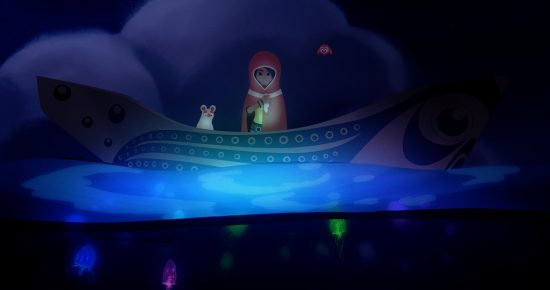 The film opens with a young fisherman glued to the screen of his phone while out at sea. He fails to notice anything going on around him. It takes a mouse dressed in traditional Haida dress tapping on a tea cup to get his attention. The mouse then spins a yarn, literally, about the young man, his lover, and their voyage to the Mountain of SGaana. He knits each scene into a long blanket, which our young fisherman interprets without issue. Perhaps due to his proficiency with emojis.
Inspired by a traditional Haida fable, this film has everything. Action, adventure, romance, and a strong female lead. What else could you ask for? It seamlessly blends traditional animation with formal elements of Haida art and music. The music alone is simply amazing – spare, haunting, and incredibly evocative.
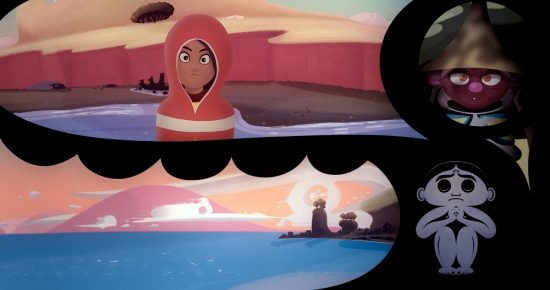 The Mountain of SGaana is filmmaker Christopher Auchter’s first film, which makes it all the more impressive. It was an official selection at festivals across the country over the past year and won the award for Best Animated Film or Series (YA 6 – 12) at the 2017 Ottawa International Animation Festival.
It’s a beautiful film. I cannot say enough good things about it. Enjoy.
oehttps://https://ift.tt/2tdMkHb
How People Got Fire
The Mountain of SGaana may have been Auchter’s directorial debut, but it’s not the first time he’s worked with us. Back in 2008, he did the animation on the film How People Got Fire, a film about a village grandmother who tells the tale of how Crow brought fire to their people.
oehttps://https://ift.tt/2mWH5YO
The post Watch Our New Animated Film: The Mountain of SGaana appeared first on NFB Blog.
Watch Our New Animated Film: The Mountain of SGaana posted first on http://film-streamingsweb.blogspot.com
Monday, 30 July 2018
Youper: AI Therapy

Youper is your emotional health assistant.
 Mental health professionals and patients who have benefited from therapy or psychiatry probably do not like to hear that the entire field could one day be replaced, as every field is threatened to be, by artificial intelligence.Of course, the probability of that occurring anytime soon is unlikely. But Youper, an “AI Therapist” you can keep in your pocket, is the first step in that direction. Despite the tech dystopian vibes that an AI therapist conjures, Youper is actually an interesting, useful technological tool for people who want to keep track of their mental well-being. It essentially is a robotic therapist, having quick conversations with users about their emotional health.
 Youper has a variety of useful features, such as the ability to track and improve your mood with quantifiable data, the option to “calm down with mindfulness sessions,” and to set and reach goals for your own emotional health. Like the most effective forms of therapy, Youper is based in science, constantly updating itself in order to adhere with the industry’s best practices. The app can help make personalized treatments for people suffering from depression and anxiety, using the collection of anonymous in order to refine and tailor results. The AI is always learning from the data people input into the app, so it should only improve with time. For now, if you want to have a conversation with a robot about your mental health, with the goal of making tangible improvements in your overall mood, Youper is worth a look.


Youper: AI Therapy posted first on http://film-streamingsweb.blogspot.com
SpotAngels: Free Community-Based Parking App
SpotAngels helps you find parking spots.
Avoid Parking Tickets
 SpotAngels is one of the simplest apps that also has incredibly useful features. There’s no fancy homepage, no complicated explanation about the product, and no unnecessary information whatsoever. There’s simply a map of a city, and a comprehensive list of parking spots available in whichever location you select. According to the site’s About page, the company has offices in both San Francisco and Casablanca. It’s goal is to “fix parking” worldwide, by showing you all your options, saving your parking location, and sending you reminders in order to ensure that you won’t receive a ticket. If you live in a congested city like San Francisco, New York, or Los Angeles, the site can be a huge help.

All The Parking Info You Need
 SpotAngels‘ team is transparent about their business model, claiming they “make money by licensing [their] parking maps to car companies.” The app is currently free, and, according to the founders, “always will be.” The site lets you enter the city in which you need parking, as well as the dates and times that your car will be left alone. The map then displays several different options, including parking garages and meters, each with the amount of money that parking would cost for the amount of time desired. There’s tons of additional useful information on SpotAngels, such as street cleaning days and other parking restrictions by date and time. Parking can be a miserable experience, but SpotAngels at least makes things a little easier.


SpotAngels: Free Community-Based Parking App posted first on http://film-streamingsweb.blogspot.com
-
I like to start all my classes with a short film, a documentary, or even a news clip to give students the opportunity to work on their liste...
-
In working towards reconciliation, we are launching a 3-year plan to redefine our relationship with the Indigenous creators and partners we ...
-
AppyPie helps you build an app with no prior coding experience. Build An App Without Coding The debate as to whether free website builder...

