Friday, 16 November 2018

This Week on NFB.ca: Leave Reality Behind and Enjoy 3 NFB Fiction Films

This week on NFB.ca we featured a small selection of films from our collection of fiction. The NFB has developed a world-wide reputation for its award-winning documentaries and animation, but we’ve also got some stellar dramas in our vaults.

These three films present a good cross-section of our offering. With Drylanders being our very first fiction film, and The Company of Strangers showing how we experimented with the genre. Finally, One Man is a great example of one of straightforward fictional dramas. Enjoy!

Drylanders

The NFB’s first-ever fiction film has an interesting story behind it. It was originally conceived as a 3-part documentary on farming and irrigation in the Prairies. After the CBC rejected that proposal, and another, the decision was made to reframe the film as a fictional feature. That’s how we ended up with this epic drama about a family who leaves Eastern Canada to stake their future in the Prairies.

oehttps://https://ift.tt/2o9ti1R

The Company of Strangers

This feature-length drama from 1990 is one of our most-beloved films. It follows the story of 8 elderly women forced to survive on their wits, memories, and some creative cuisine when their bus breaks down in the wilderness. It’s fiction, but it’s like the precursor to reality television, featuring non-professional actors and unscripted dialogue. But this is a heart-warming story of friendship and teamwork rather than a backstabbing saga of conspiracies and alliances.

oehttps://https://ift.tt/2GQqZbL

One Man

This film from the late 1970s comes to us from the late Robin Spry, who was at the time well-known for his documentary Action: The October Crisis of 1970. In this fiction film, reporter Jason Brady finds himself up against Big Business and caught in an impossible situation: Does he risk his job and his marriage in an attempt to bring down the system?

oehttps://https://ift.tt/2FqFbvL


The post This Week on NFB.ca: Leave Reality Behind and Enjoy 3 NFB Fiction Films appeared first on NFB Blog.


This Week on NFB.ca: Leave Reality Behind and Enjoy 3 NFB Fiction Films posted first on http://film-streamingsweb.blogspot.com

One Man: Why You’ve Probably Never Seen This Great Canadian Drama

Tuesday, 13 November 2018

Art & AI:  artistic residency in research/creation and artificial intelligence | Call for applicants

The National Film Board of Canada (NFB), the Quartier des Spectacles Partnership (PQDS), Element AI, Google and the Conseil des arts de Montréal (CAM) are joining forces to offer a Montreal-based professional artist or professional art collective a research and creation residency for a duration of six months.

The residency, which includes a budget of $50,000, will allow the artist or collective to collaborate directly with artificial intelligence (AI) developers and researchers, provide access to the latest advancements in AI, and expose AI researchers and developers to creative approaches different from those they are already familiar with.

As well as enabling discussions around the possibilities and issues associated with AI, this residency is intended to be an opportunity to address the potential role of AI in future urban development.

Objectives

The residency is designed to meet the following objectives:

  • Support and stimulate collaboration between two of Montreal’s most vital professional communities (AI and the art world)
  • Give artists an opportunity to access the latest developments in AI
  • Give artists a setting where they can do research and creative work with the aim of developing a prototype artwork incorporating AI
  • Give AI researchers and developers a creative perspective on their work, as well as the possibility of developing AI tools in collaboration with artists
  • Spark discussions on the impacts and potential of AI in art
  • Develop a prototype for an artwork, experience or installation suitable for presentation in a public space, featuring an original use of the possibilities enabled by AI
  • Encourage discussion on the potential role of AI in future urban development and citizen participation

Eligibility

This residency is for professional artists or professional art collectives working in any discipline and residing on the Island of Montreal, including both Canadian citizens and permanent residents. Each art collective must have a majority (50%+1) of Canadian citizens or permanent residents as members, and a majority (50%+1) of members must reside on the Island of Montreal. The person in charge of the application must also reside on the Island of Montreal.

Selection criteria

Proposals will be evaluated by a committee composed of representatives of the partner organizations (NFB, PQDS, Element AI, Google and CAM) and other representatives of the artistic community, using the following criteria:

  • Relevance of the project’s use of AI
  • The quality of the artistic approach and previous work
  • Interest in the reflection on the city of the future and citizen participation
  • Potential for cross-pollination between the art and AI communities
  • Feasibility 

Evaluation process

After confirmation of the eligibility and feasibility of the project by a committee of AI experts, finalists will be selected and invited to present their proposal to a selection committee and AI experts.

The selection committee’s decisions are final and cannot be appealed. Applicants agree not to contact, at any time, any member of the selection committee on any matter related to the management, evaluation or decision-making related to their submission. Only the staff of the Quartier des Spectacles Partnership will be allowed to answer applicants’ questions.

Rights ownership

The winning artist or collective will retain ownership of all rights to the proposal submitted. All applicants grant the National Film Board of Canada and/or the Quartier des Spectacles Partnership rights of first negotiation and final refusal for securing the rights to exclusive production of the project, with the aim of developing, producing or co-producing the work at the conclusion of the residency, under terms to be negotiated in good faith with the artist or collective.

Duration of residency and amount of budget

The duration of the residency is six months, from April to October, 2019. 

Element AI will make staff, office space and equipment available to the artist or collective. The artist or collective selected will be able to produce their work with a total of 200 hours of support from qualified professionals. The equipment and professionals will be selected based on the details of the project.

The amount awarded to the artist or collective will be $50,000. These funds are to be used to cover artists’ fees, other contributors’ fees, and the costs of producing a prototype.

The other partners will provide guidance consistent with project requirements and each partner’s respective expertise.  

Schedule

  • Call for proposals issued: November 13, 2018 – Soirée Composite – HUB Montréal
  • Deadline for submitting proposals: January 25, 2019 at noon
  • Naming of finalists by the selection committee: February 12, 2019
  • Finalists’ presentations (30 minutes each): February 21, 2019
  • Announcement of winner: March 2019
  • Planning meeting with the artist or collective, residency partners and AI experts: March 2019
  • Residency: April to October, 2019
  • Presentation of the prototype and delivery of a final activity report: fall 2019

How to submit a proposal

All submissions must include:

  • a project description indicating compliance with selection criteria (intent, approach, connection with AI…)
  • an overview of requirements for support and equipment
  • summary budget and schedule
  • name of the artist or list of members of the collective and abridged CVs for collective members or the artist, including previous works or links to them.

The project description must not exceed five single-sided pages (any additional pages will not be read).

The application must be submitted in a single copy in 8 ½ x 11 in. (21.6 cm x 27.9 cm) format, and delivered by email only. Only the required documents will be sent to the members of the evaluation committee.

To submit your proposal, please email your documents before noon on January 25, 2019 to projets@quartierdesspectacles.com. If your submission has a large file size, please use the WeTransfer service.

If you have any questions, send them to projets@quartierdesspectacles.com.

The post Art & AI:  artistic residency in research/creation and artificial intelligence | Call for applicants appeared first on NFB Blog.


Art & AI:  artistic residency in research/creation and artificial intelligence | Call for applicants posted first on http://film-streamingsweb.blogspot.com

Watch Talking at Night and Get an Inside View of a Mobile Crisis Centre

Last year, we produced three films under the Doc Lab Saskatchewan banner. We featured Kristin Catherwood’s Ride about a couple of months ago, and now we’re turning the spotlight on Eric Thiessen’s Talking at Night, about Saskatoon’s 24/7 Mobile Crisis Centre.

The crisis centre has been around for almost 40 years and its workers are on the front line, dealing with urgent and unpredictable situations. They are often the only thing standing between the caller and tragedy. Talking at Night captures the reality of their working lives, quietly observing as these trained professionals deal with everything from suicide prevention to self-harm to child abuse.

Talking at Night – An Idea Is Born

Talking at Night is a small film that takes on a big issue and is successful in its efforts. The need for the crisis centre is clear. There are so many people out there in pain, or in trouble. As part of the Doc Lab Saskatchewan requirements, the documentary needed to be observational in style, with no music, narration or interviews. Thiessen felt the Mobile Crisis Centre was a great candidate, as it provided an environment that audiences could easily immerse themselves in.

“Putting a camera in their small call centre and following the operators’ side of the conversation would be very engaging to viewers, as they would be piecing together an urgent conversation… and get a look at a vital service that few people are even aware of.”

Making an Observational Documentary

Despite what the name might make you think, observational documentaries do require quite a bit of prep work. Since this was a first for Thiessen, he wanted to be sure he was ready. He spent time at the centre and interviewed employees. Listening to them take calls also helped. Then he photographed potential shots and visuals. As he says, “Even though you never know what you’re going to get, you plan as if you do.”
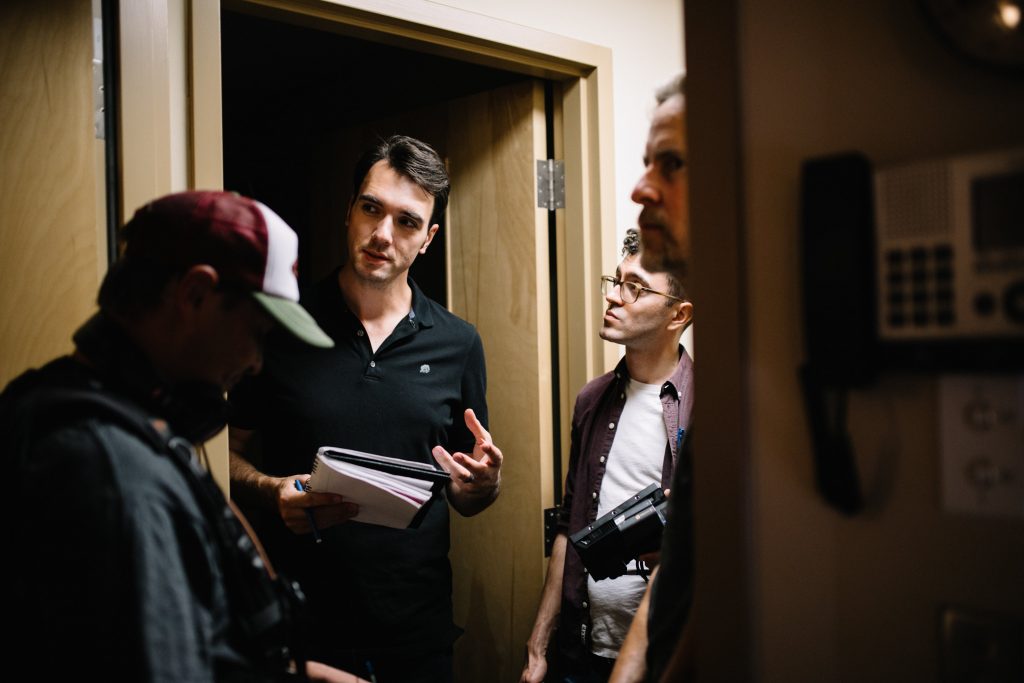
 

As the film was more experiential than narrative, Thiessen also wrote how he imagined the film would unfold. This way, he could visualize when the pace would quicken and when it would relax. He admits it’s difficult to write for this form. It requires “a tricky balance of vague specificity.” But in order to orient your crew and get them on board, they need a vision to follow.

“If the final version is different from what you set out to make, that’s okay – but you need a place to start from.”

Eric Thiessen, Filmmaker

Thiessen has worked in the Saskatchewan film and video industry for over a decade. Most of his experience is in corporate video and factual series for Canadian TV. He has worked as both a videographer and writer. He also studied Canadian historical films as a focus of his masters’ degree at the University of Calgary. Today, he teaches film history at the Recording Arts Institute of Saskatoon.

Doc Lab Saskatchewan appealed to Thiessen. It provided him the opportunity to work with the NFB, something he had already set his sights on. He was also inspired by the challenge of making a short observational documentary, something completely new to him. But perhaps most importantly, it was the fact that he’d be able to showcase the Mobile Crisis Centre. On a national platform. It was vital to him that people be aware of the services they provide.

“While it’s obviously an important service, and they do inspiring and tremendous work, the calls they receive are a direct reflection of the anxieties and issues facing the people of Saskatoon, and, I would argue, the Canadian population.”
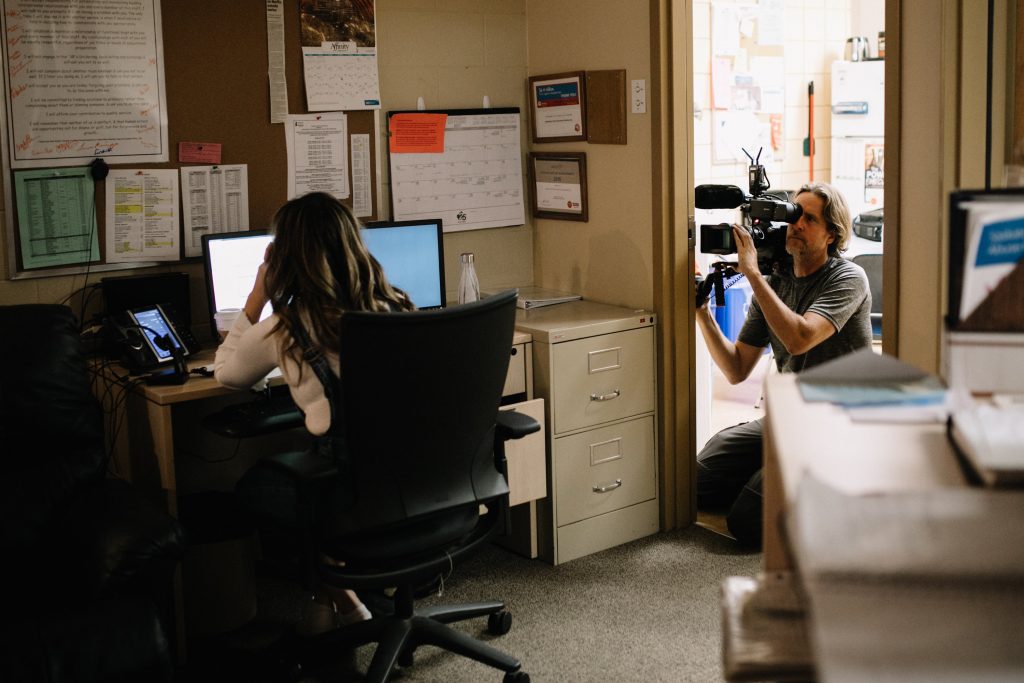
The Doc Lab Saskatchewan Experience

Making Talking at Night with Doc Lab Saskatchewan was a fantastic way for Thiessen to work with the NFB. The process was a fast one, moving from concept to completed film in two months.

“I met with filmmaking experts every step of the way, including my director mentor, Robin Schlaht, my editor, John Gurdebeke, and the post-production team at the NFB studios in Montreal. I felt welcome and supported through the entire process.”
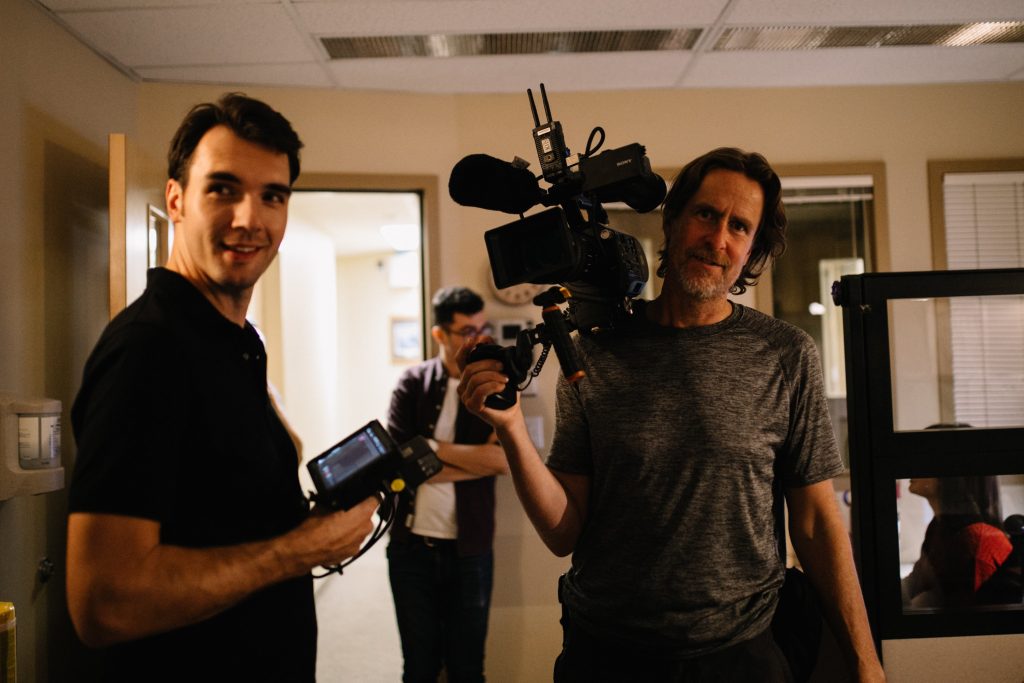
There was a lot of planning during prep. The crew couldn’t anticipate the level of activity at the Mobile Crisis Centre and needed to be ready. Shooting took place over two nights, using the quieter of the two to get insert shots, close-ups, and some b-roll.

The opportunity to work with editor John Gurdebeke was a big part of the learning experience for Thiessen. “I’ve edited most of my own projects for years, so it took some adjusting on my part to get used to sitting back from the keyboard. John is a really talented editor with a fantastic eye… he’s great at listening to my vision and finding ways to express it that I never would have considered, but ultimately loved.

“This whole project is a perfect example of how great things happen when you work with a team of strong and talented people; the finished film is far better than anything one person could make alone.”

oehttps://https://ift.tt/2z6lALA

Talking at Night is one of three films produced as part of Doc Lab Saskatchewan. The program is a collaboration between The National Film Board of Canada, Creative Saskatchewan, and the Saskatchewan Filmpool Cooperative

The post Watch Talking at Night and Get an Inside View of a Mobile Crisis Centre appeared first on NFB Blog.


Watch Talking at Night and Get an Inside View of a Mobile Crisis Centre posted first on http://film-streamingsweb.blogspot.com

Saturday, 10 November 2018

This Week on NFB.ca: Watch 5 Films in Honour of Remembrance Day

This week on NFB.ca we paid tribute to all the veterans as we marked Remembrance Day with a collection of war-themed films. The Canada at War Series is a classic from Donald Brittain and will only be available for a limited time, so watch it while you can. And we’re pleased to bring you Currie’s Dilemma, just added to our online collection.

However you choose to mark Remembrance Day, just make sure you take the time to be grateful for the sacrifices of those who came before you. As well as those who serve now, so that you can remain safe. If you get the chance, thank a veteran when you pick up your poppy.

The Canada at War Series

New online in honour of Remembrance Day, this 13-part series chronicles Canada’s involvement in WWII from 1936 – 1946. Writer/producer Donald Brittain masterfully recounts the tale from the early signs of trouble in Germany to the end of the war and the founding of the United Nations.

oehttps://https://ift.tt/2JTrTX1

Paris 1919

Filmmaker Paul Cowan takes on Margaret MacMillan’s acclaimed book and brings us back to the end of WWI and the most ambitious peace talks in history. Using reenactments and a strong, vivid narrative, he manages to bring us right back to that moment when anything seemed possible.

oehttps://https://ift.tt/2z37ayv

The Van Doos, 100 Years with the Royal 22e Regiment

Remembrance Day is a time for reflection and paying tribute to the both the living and lost soldiers of war. This film does exactly that. Produced in 2014, it marks the 100th anniversary of the Royal 22e Regiment (known affectionately as the Van Doos). It chronicles some of the personal stories to emerge from the only French-speaking Canadian battalion.

oehttps://https://ift.tt/2JV8PYv

Return to Vimy

Released in honour of Remembrance Day 2017, this short film memorializes the soldiers who fought at Vimy through a series of animated sketches. It’s a loving homage from a young woman to her great-grandfather, as she transforms his words into images to reflect the lives of soldiers.

oehttps://https://ift.tt/2AXJzhu

Currie’s Dilemma

This short film about Sir Arthur Currie uses rare, silent footage culled form the NFB’s archives. Colourized and given sound, the film dramatizes what was perhaps the most difficult decision in Currie’s career: whether or not to commit his men to one of the most dangerous operations of the war.

oehttps://https://ift.tt/2RMXexr

The post This Week on NFB.ca: Watch 5 Films in Honour of Remembrance Day appeared first on NFB Blog.


This Week on NFB.ca: Watch 5 Films in Honour of Remembrance Day posted first on http://film-streamingsweb.blogspot.com

Wednesday, 7 November 2018

Wikishirts: Procedurally Generated Shirts From Wikipedia

Wikishirts sells shirts on any topic you like.

Wear Wikipedia

Almost everyone should, at this point, know what Wikipedia is. It’s one of the most popular sites on the web, as well as one of the most useful. Wikishirts, though unaffiliated with the volunteer-run free online encyclopedia, sells shirts that are procedurally generated from Wikipedia’s content. Each of the shirts are printed on white fabric, with Wikipedia’s signature combination of black and blue text. At the top of each shirt is the bolded word of your choice, followed by the description of whatever it is that you chose, which is pulled straight from Wikipedia. Each of the shirts costs $29.99.

Weird Shirts

Wikishirts sells people on their strange idea by including a search box that asks “what’s your weird obsession?” In the FAQ of the site, those behind the concept explain that they created Wikishirts in order to help people better express their fashion in ways that big box stores don’t offer. Literally anything could be printed on a Wikishirt, and the owner should be willing to wear it with pride. The company also ships worldwide for free, and donates 10% of their profits to Wikipedia. It’s a goofy, gimmicky idea, but it is fun to see Wikipedia articles printed on shirts. If you have a weird obsession, consider checking Wikishirts out.


Wikishirts: Procedurally Generated Shirts From Wikipedia posted first on http://film-streamingsweb.blogspot.com

How We Selected 80 NFB Productions to Commemorate Our 80th Anniversary

As part of our commemoration of the National Film Board’s 80th anniversary, we decided to choose a symbolic 80 powerful productions to high...